
Guide · 9/28/2026
The Porsche Panamera Steering Wheel Guide: 970, 971 and 972
A chassis-by-chassis guide to the Porsche Panamera steering wheel: 970, 971 and 972 fitment checks, donor cores, factory functions and coding conditions.
Most Panamera owners start shopping for a steering wheel for one of three reasons. The original rim is worn. The cabin feels dated. Or the wheel does not suit the driver.
Which wheel your car can carry matters more than the finish. A Porsche Panamera steering wheel upgrade is a compatibility project first. This guide covers the 970, 971 and 972 chassis.
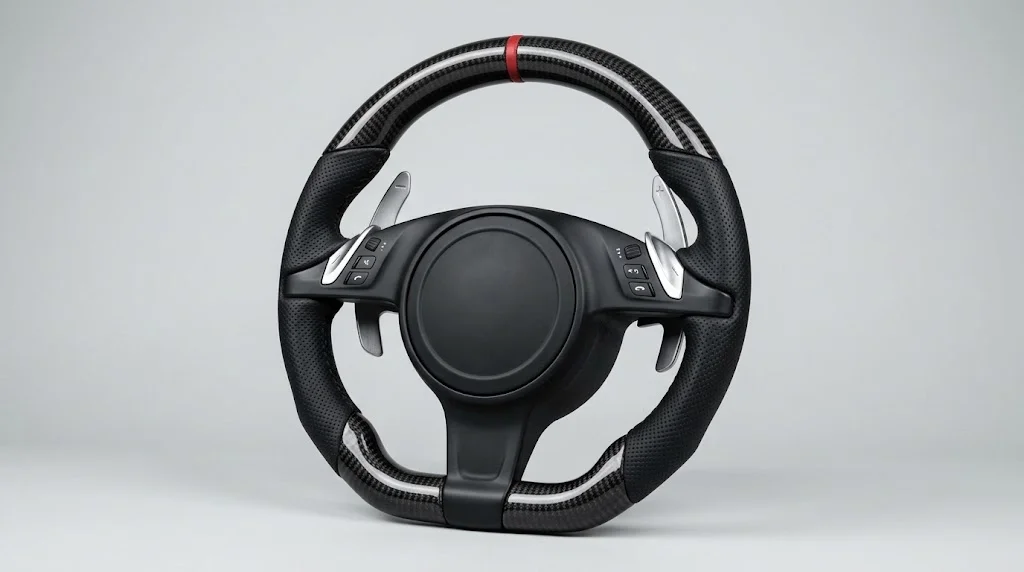
Studio front view of a custom Panamera steering wheel. Perforated black leather side grips and carbon fiber trim on the lower spokes. A red 12 o'clock centring stripe, multifunction buttons and aluminium paddle shifters, on a smooth light grey backdrop.
Quick Fitment Summary
Each generation has its own wheel family, airbag shape and button layout. Treat these summaries as a starting point, then verify against your car. Current builds are listed on the Panamera fitment page.
Panamera 970 (2010-2016)
First-generation Panamera. Many 970 cars carry a larger center pad and an older switch layout. Shift buttons rather than paddles appear on early examples. Paddle, heating and Sport Chrono fitment follow the original option list.
Panamera 971 (2017-2023)
Second-generation Panamera. The GT-Sport layout is common here, with a round airbag, a mode dial on the wheel and PDK shift paddles. Most custom requests come from this generation.
Panamera 972 (2024-present)
Third-generation Panamera, launched in late 2023 for the 2024 model year. Some configurations add capacitive hands-on detection. Model numbering can differ between catalogs and markets, so confirm your car by VIN rather than by the code alone.
Why Upgrade Your Porsche Panamera Steering Wheel
Wear shows up first. Leather goes shiny at 9 and 3 o'clock, and stitching flattens. A worn rim also feels thinner in the hand.
There is a generational gap as well. Early 970 cars carry an older switch layout and a larger center pad. Later 971 and 972 cabins are tighter and more digital.
Best Porsche Panamera Steering Wheel Options
Three build directions cover most orders. All three keep the same donor core, so only the skin and rim shape change.
Carbon Fiber: Gloss, Matte and Forged
Continuous-weave carbon fiber is laid by hand and cured under heat and vacuum. Gloss shows the weave, and matte hides fingerprints. Forged carbon compresses chopped fiber in a mold.
Alcantara
Alcantara has a dry, high-friction surface that stays planted in summer. It needs brushing and periodic cleaning. Drivers often choose it for the rim and leather for the side grips.
Nappa and Perforated Leather
Nappa leather breathes and wears evenly, and perforated Nappa adds small vent holes. Both suit a daily-driven car.
| Build | Look | Grip in summer | Long-term care |
|---|---|---|---|
| Gloss carbon fiber | Deep, reflective weave | Warm to the hand | Wipe with a soft cloth |
| Forged carbon | Marbled, matte-leaning | Warm to the hand | Same as gloss, no polish |
| Alcantara | Matte, suede-like | Stays dry and planted | Brush and clean periodically |
| Perforated Nappa | Classic leather grain | Breathes, warms slowly | Condition twice a year |
How to Confirm Your Panamera Steering Wheel Fitment
Fitment is not decided by the chassis code alone. The model year, the factory options, the wheel configuration and the original modules all matter. Two cars with the same code can carry different airbag plugs and paddle types.
For that reason, every Porsche Panamera steering wheel order starts with verification. We also check airbag compatibility from the module type, the airbag shape and the connector. Have these details ready before you order:
- VIN - confirms the chassis, the market and the model year.
- Vehicle year and market (US, EU, Middle East or other).
- Photos of your current wheel, front and back, with the airbag connector.
- Option list - does the car have Sport Chrono with the mode dial?
- Heating - is the original rim heated?
- Paddles - are PDK paddles fitted, and are they aluminum or plastic?
- Controls - which buttons sit on the wheel today?
- Drive side - left-hand or right-hand drive.
With those details we confirm the core, the airbag type and the functions to keep. Send your VIN and photos via our inquiry form or the contact page before you order.
Factory Functions You Can Retain
A custom build keeps the parts that already work. The restraint module, the wheel controls and the factory wiring channels stay in the car wherever they were specified.
| Function | Typical approach | What we verify |
|---|---|---|
| Airbag (restraint module) | Original factory module reused, non-invasive pin-to-pin alignment | Airbag type and connector |
| Sport Chrono dial and Sport Response | Original switchgear transferred where factory-fitted | Option list and switch housing |
| PDK paddles | Factory paddle module retained | Paddle type and mounting points |
| Heated rim | Original element and circuit retained where factory-fitted | Heating option and connector |
| Steering wheel controls | Original buttons and LIN-bus scroll wheel reused | Button layout and connector |
| Lane keep assist | Vibration motor position preserved | Driver assistance module |
A rim cannot add a function the car was not built with. A car without factory heating or Sport Chrono will not gain it from a rim.
OEM Donor Core vs Aftermarket Replacement
An OEM replacement core and a generic aftermarket frame can look alike. Three details separate them: the spline interface, the module mounting points and the material of the core.
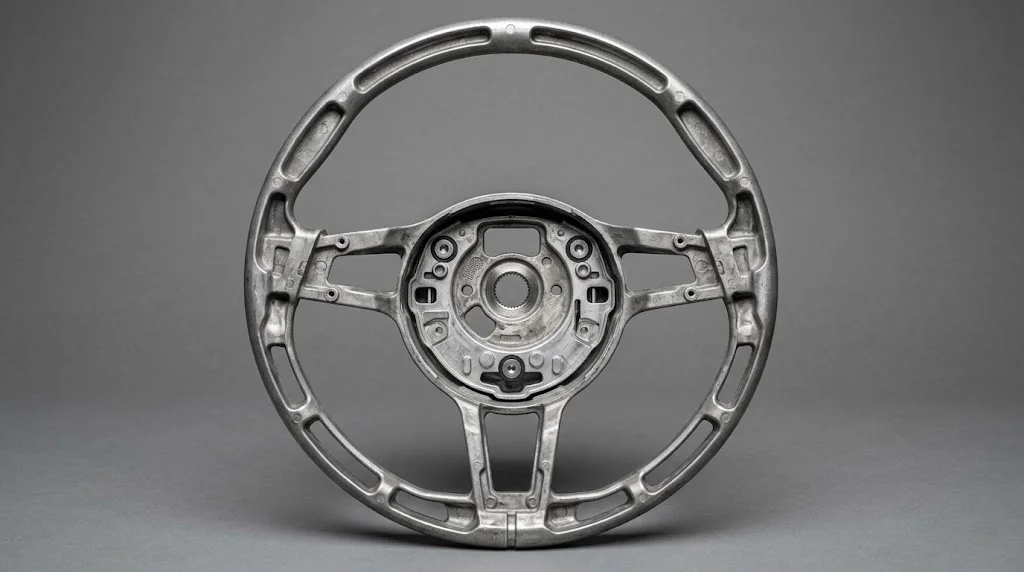
A studio view of the OEM-type core: spline hub, spoke roots and the restraint module mounting points that set the fit and the airbag position.
We build on an original OEM donor core for your chassis. Its spline interface is designed to preserve factory steering-column engagement when the correct core and service procedures are used. The restraint module keeps its position and angle.
A generic frame may not carry the same mounting bosses, thread inserts or column seating.
Load path through the column
----------------------------
  rim load --> spoke root --> center hub --> spline --> steering column
                                     |
                                     +--> restraint module (fixed position)
|
Custom Materials
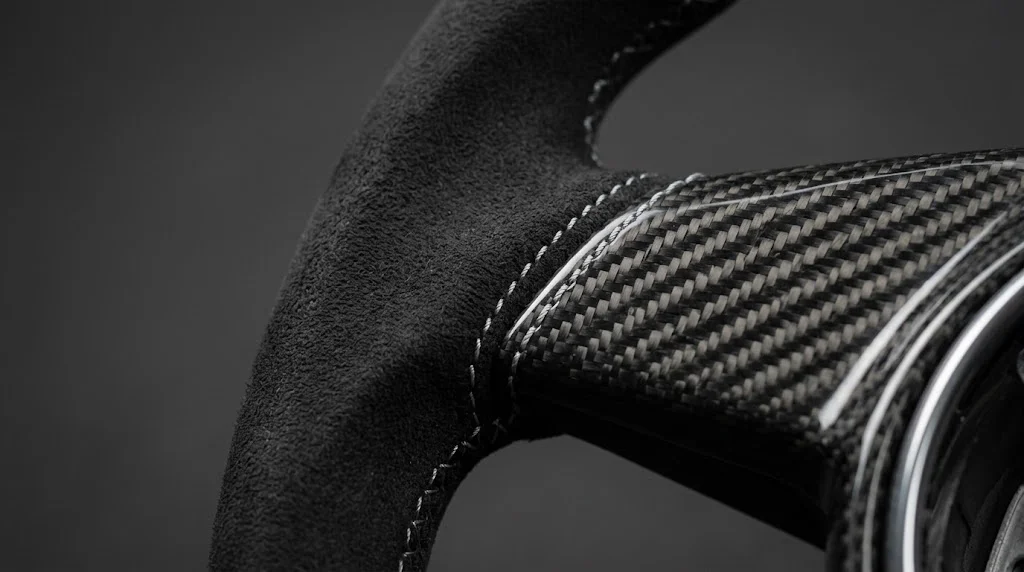
Close-up of a typical material mix: Alcantara side grips, carbon fiber weave and contrast stitching. Stitch color and leather grade are chosen per order.
Material changes grip, care and appearance, not how the core mounts. A carbon fiber steering wheel can use Alcantara grips, Nappa bolsters or perforated leather. All of them can be built as a custom Porsche steering wheel on the same core.
Flat-Bottom vs GT-Style
A flat-bottom rim adds leg room and a clear hand reference at the bottom of the wheel. A GT-style round rim keeps the classic Porsche profile.
Both shapes can be built on the same donor core, and the restraint module stays in its original position and angle.
Installation and Safety
Steering-column work sits inside the Supplemental Restraint System (SRS). The restraint module has a fixed position and angle relative to the driver.
Battery isolation, careful handling and the fastening sequence from the manufacturer's workshop manual (WM / PIWIS) all matter. A certified automotive technician should carry out the fitting, following authorized workshop manual procedures. We do not quote torque figures, because they differ by chassis and fastener.
After fitting, check the horn, the buttons, the paddles, the heating and the instrument cluster. Report any existing warning light before the build, not after. Our installation guide covers the general sequence.
Coding: When It May or May Not Be Required
Coding is the question buyers ask most, and the honest answer is conditional. When the original steering wheel module, the wiring connectors and the vehicle-specific parts are reused, additional coding may not be required. Compatibility should still be confirmed against your car's configuration before installation.
A different module family, or a part the car expects but does not have, may call for a diagnostic session. A qualified technician carries out that work with the manufacturer's diagnostic tooling. We will tell you before you order.
Signal flow after the swap
--------------------------
  clock spring --> factory harness --> column module --> CAN / LIN bus
       ^                                                     |
       |                                                     v
  buttons / paddles / heating --- same factory channels --- cluster
|
Common Compatibility Problems
These issues come up most often when a Panamera wheel is ordered without verification.
- Airbag connector mismatch. Generations use different plugs, so a photo of your connector lets us match the build.
- Triangular versus round airbag. Cars from 2010 and 2016 can differ, so the core has to match the airbag shape.
- Shift buttons instead of paddles. Button-type shifters were common on early cars, so the core must support what your car has.
- No Sport Chrono package. A rim cannot add an option the car was not ordered with, and a marker is not a working dial.
- Heated rim wiring. The element and its circuit are transferred on a heated car. A non-heated car cannot gain heating.
- Capacitive hands-on detection. The sensor layer on 972 cars has to be accounted for in the build.
- Right-hand drive layout. Spoke layout, buttons and paddle positions are handed, so state the drive side when you order.
Before You Order: Configuration Checklist
- Generation and chassis code confirmed from the VIN.
- Vehicle year and market recorded.
- Photos of the current wheel, front and back.
- Factory functions to keep: Sport Chrono, heating, paddles, lane keep assist.
- Restraint module: original airbag unit reused.
- Material and finish: gloss or forged carbon, Alcantara, Nappa, stitch color, 12 o'clock marker.
- Rim shape: flat bottom or GT-style round.
- Drive side, plus any existing warning lights.
Frequently Asked Questions
Can I keep my original airbag?
On most builds the original factory restraint module is reused, with non-invasive pin-to-pin alignment. A few special editions differ, so send a photo of your airbag and its connector.
Can I keep the Sport Chrono dial and the Sport Response button?
Where your car was specified with them, the original switchgear is transferred. A car without the package cannot have a functional dial.
Can I keep my heated steering wheel?
If your original rim is heated, the element and its circuit are retained. A car that left the factory without heating cannot gain it from a new rim.
Can I upgrade to carbon fiber without replacing the electronics?
Yes, in most cases. The composite skin sits on the donor core, and the original modules and connectors are reused. That keeps the buttons, the paddles and the heating working.
Can I order a flat-bottom wheel for a 971?
Yes. Flat-bottom and GT-style rims are both built to order for the 971. The restraint module keeps its original position and angle.
Can you build from my original core?
In most cases we supply an original OEM donor core for your chassis. If you would rather send your own core, contact us first so we can check its condition, spline wear and module compatibility.
How do I confirm Porsche Panamera steering wheel compatibility before ordering?
Start with your VIN and clear photos of your current wheel, front and back. Add your vehicle year, market, drive side and the options to keep. We confirm the core, the airbag type and the retained functions before production begins.
Why Choose CASSERON
CASSERON is the brand of Guangzhou Yingjie Technology Co., Ltd. We design and build custom steering wheels in our own factory in Guangzhou, China. Read more on our About page.
- Fitment confirmed before production. We check your VIN, photos and option list, then build to that specification.
- Made to order. Every wheel is hand-built for one car, not pulled from a shelf.
- Factory functions retained. Where your car was specified with them, the original connectors and modules are reused.
- More than 13 years of experience in design, engineering and manufacturing.
- Inspected before dispatch. Every wheel is inspected before it ships, then packed in a high-density foam box.
- 3-year warranty covering manufacturing defects under normal use.
- Tracked worldwide delivery. Production takes 10-15 business days, transit takes 15-20 business days, and a tracking number is provided once your order ships.
Price depends on the core, the materials and the options, so we confirm the quote before production. Returns follow our published returns policy, and lead times are listed in the shipping policy.
What About the Vehicle Warranty?
An aftermarket steering wheel does not automatically void a vehicle warranty under U.S. federal warranty law, but warranty coverage can still depend on whether the modification caused the specific failure being claimed.
Related CASSERON Guides
🔗 Topic: Porsche Panamera fitment hub — every Panamera wheel we build for the 970, 971 and 972.
🔗 Topic: All Porsche fitments — 911 (996 to 992), 718, Boxster, Cayman, Macan, Cayenne and Taycan.
🔗 Topic: CASSERON FAQ — ordering, payment, shipping and warranty questions in one place.
🔗 Topic: Panamera 970 / 971 / 972 Real Carbon Fiber Steering Wheel — the carbon build for this chassis range.
🔗 Topic: Custom Black Leather Steering Wheel for Porsche Panamera — the leather-led build, same core and electronics method.
Request a Custom Porsche Panamera Steering Wheel
Send your VIN and photos of your current wheel. We confirm the core, the airbag type, the functions to retain and the material options before production starts. For a Panamera steering wheel replacement or a retrofit, that check comes first.
Next steps: Panamera steering wheels · all CASSERON wheels · request a custom build · contact us.
Further reading: FTC — A Businessperson's Guide to Federal Warranty Law · NHTSA — Air Bags.