
The Porsche Cayman Custom Steering Wheel Guide
How to specify a custom steering wheel for a Porsche Cayman or 718 Cayman, from 981 to 982 and GT4: fitment checks, materials and installation.
Read More →Guide · 10/7/2026
How to specify a custom steering wheel for a Porsche Boxster or 718 Boxster, from 986 to 982: fitment checks, materials, installation and coding.
The Boxster is the Porsche you can drive with the roof down, and that changes what the wheel has to cope with. Sun, wind and sudden temperature changes reach the rim directly in a way they never do in a coupé. Owners also notice the wheel most when the top is open, because there is nothing else to look at. A custom Porsche Boxster steering wheel renews the one surface that faces the weather.
The 718 nameplate covers two generations, and earlier cars carry their own chassis codes. Locate your row below, then let us confirm the detail.
| Chassis | Model and typical years | What usually matters |
|---|---|---|
| 981 | Boxster, 2012 to 2016 | Older button frame and a different airbag connector |
| 982 | 718 Boxster, 2016 onwards | Newer centre, and paddle hardware on PDK cars |
| 987 | Earlier Boxster, 2004 to 2012 | Early three-spoke layout, confirm before ordering |
| 986 | First-generation Boxster | Oldest electronics, confirm before ordering |
A Porsche Boxster steering wheel cannot be shared across those generations. The centre and the button cluster changed between them, so the chassis code always comes first.
An open car punishes a rim. For a car with no roof, a Porsche Boxster steering wheel is the part that faces the weather. Ultraviolet light, wind-blown dust and sun cream all reach the surface that a coupé protects. The upper arc of the rim takes the worst of it, and leather that has seen ten summers goes hard before it looks worn.
The material choice follows from that. The suede holds its grip in heat and resists glare from a low sun, which is why Porsche fits it to the GT cars. Matte carbon keeps a low sheen along the upper and lower rim. Guards red stitching is the traditional Porsche accent, and it suits a black cabin particularly well.
Four finishes cover almost every Boxster order we build. Each Porsche Boxster steering wheel starts from how the car is used. The grid compares how each copes with sunlight and wind.
Alcantara delivers the strongest grip and reflects almost no light, which matters more in an open car than a closed one. Bare hands leave oils in the nap, so a gentle brush every few weeks keeps it alive. It also stays cooler to the touch than leather after the car has stood in the sun.
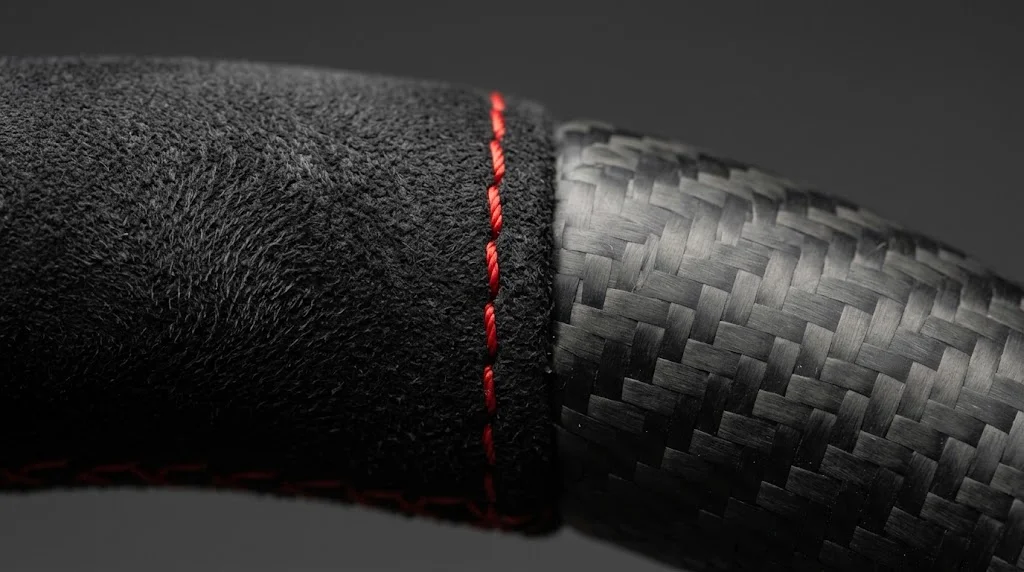
Matte carbon has a woven surface under a flat coat, so it hides dust and fingerprints far better than a gloss finish. An open car collects dust quickly, and this is the finish that forgives it.
Smooth leather matches what Porsche fits itself and is the easiest surface to wipe down after a dusty drive. It is the softest option over a long journey.
Perforations add ventilation where the palms sit. In a car with no roof, that keeps the grip predictable on a hot afternoon with the heater off.
| Finish | How it feels | Care | Suits |
|---|---|---|---|
| Black Alcantara | Firmest grip, no glare | Brush every few weeks | Open-top driving in sun |
| Matte carbon | Low sheen, hides dust | Wipe over | Dusty environments |
| Smooth leather | Softest of the four | Damp cloth | Long journeys |
| Perforated leather | Cool and dry | Balm twice yearly | Warm climates |
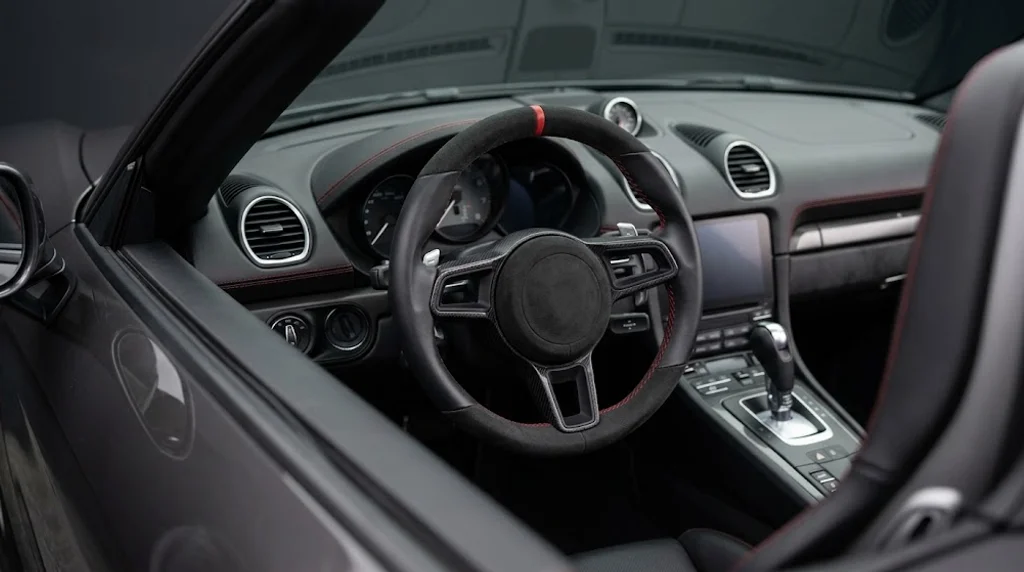
Four items answer most enquiries. Provide the chassis number and the full options list. Provide a daylight picture of the face and a second of the rear, airbag out. Whether a Porsche Boxster steering wheel is right for your car rests on those details rather than on the badge.
The images show us the spoke profile, the button cluster and the connector. Paddle hardware and the Sport Chrono dial both vary across the range, so the options list matters. We build nothing until the match is confirmed, and we will ask for a sharper photograph rather than guess.
A better rim should not cost you a working control. Our builds reuse the frame and harness already fitted to your car.
| Function | Typical outcome |
|---|---|
| Airbag | Original module normally reused; cover built to suit it |
| Sport Chrono mode switch | Depends on the original wheel and dial; confirm first |
| PDK paddle shifters | Retained on cars that have them; cut-outs specified at order |
| Heated rim | Depends on the heating element and trim; confirm first |
| Multifunction buttons | Retained when the original button frame is reused |
Two hidden items each need a photograph. One is the heating element, and the other is the hands-on sensor the assistance systems use.
Rebuilding the wheel already in the car keeps every electronic part as Porsche made it, which is the safer route on a newer 982. The frame, the harness and the paddles all stay standard.
A newly made core is the other path, and it leaves you with the original wheel for later. That suits a car on finance that must return to standard. On a 986, used wheels turn up often enough that a donor is usually cheaper.
Pairing black Alcantara with matte carbon is the combination that suits an open car best. The carbon sits along the upper and lower rim, and the Alcantara covers the grips. Guards red stitching then gives the wheel the traditional Porsche accent.
A round rim keeps the wheel continuous through every input, which suits a roadster on a twisty road. A flat lower section gives taller drivers more clearance and echoes the motorsport look. Neither shape changes the steering itself, so decide on comfort and on how you want the cabin to read. Roof down, the wheel is also the part you look at most. The finish therefore matters more here than in a fixed-roof car.
With an airbag in the assembly, this belongs with someone experienced. Isolate the battery and let the car shut down completely before loosening fasteners. Follow Porsche procedure for your chassis rather than a general walkthrough. Set the module on something soft, and torque the centre fastener to the figure in the workshop manual. No other source should be used for it.
Take the car out briefly and check the wheel tracks straight. Check each control in turn, including paddles and horn. A warning lamp that stays lit means the car should be read before driving further.
Warranty questions follow any modification. An aftermarket steering wheel does not automatically void a vehicle warranty under U.S. federal warranty law, but warranty coverage can still depend on whether the modification caused the specific failure being claimed.
Coding depends on the car rather than the finish. If the factory module, the harness and the vehicle-specific parts all stay in place, extra coding may be unnecessary. A module taken from another generation changes things, and the control unit may then need to learn what is fitted.
Because that differs between cars, we call coding a possible step rather than a promise. Send the chassis number with images of both electronic units and we will say whether a workshop trip looks likely.
What goes wrong on these cars follows a few routes. A wheel bought from another generation often shares the badge but not the button frame, and the cluster exposes it quickly. A Sport Chrono mode switch fitted to a car that never had one leaves an unused connector and a control with nothing to do. The opposite error appears just as often. Paddle hardware differs across the range, so the wrong set leaves paddles that do nothing. A cover cut for a GT airbag arriving on a standard car is the quiet cosmetic failure. The four checks above clear all of them.
No. Their centres and button clusters differ, so each car needs its own build even when the materials match.
Often yes. The paddles must suit the wheel fitted, so tell us which type is present and we will confirm compatibility first.
Where the factory fitted one, usually yes. It depends on matching the matting, which we confirm from photographs.
Only for a donor build. A newly made core leaves your original with you.
Expect ten to fifteen working days in the workshop and fifteen to twenty in transit. The complete span is normally twenty-five to thirty-five days.
Sun and dust do accelerate wear faster in these cars. The suede or a matte finish usually outlasts smooth leather as a result.
Your Boxster rim begins as a chassis number rather than a part number. The 718 patterns we offer rest on more than thirteen years of design, engineering and production, all of it done in our own Guangzhou workshop. Alcantara, carbon, stitch colour and rim shape remain your calls, cleared against your car before the first cut. Shipping is tracked on every order, the warranty lasts three years, and returns are open for thirty days by RMA request.
Our 718 Cayman guide covers the fixed-roof sibling, and most of the finishes described here appear in it too. The full range sits in the shop, and the Porsche pages are Porsche fitment, the 718 Boxster listing and the 718 Cayman listing.
Photograph the wheel where it sits, add the chassis number and the options list, and send them over. We will reply with a confirmed build and a date before we make your Porsche Boxster steering wheel. One catalogue entry is listed for this platform: the carbon fibre wheel covering the 718, 986, 987, 981 and 982 series.
Further notes are there if you need them. The installation guide covers battery isolation and the airbag, and the FAQ answers the common questions. Fitment and delivery queries can go through the inquiry form, or the contact page. Timings are set out in the The about page covers the Guangzhou workshop in more detail. shipping policy, and returns are governed by the return and refund policy. The FTC covers American warranty law, and NHTSA covers air bag safety.
How to specify a custom steering wheel for a Porsche Cayman or 718 Cayman, from 981 to 982 and GT4: fitment checks, materials and installation.
Read More →How to specify a custom steering wheel for a Porsche 911 991 or 992: fitment checks, the factory functions you can keep, materials and installation.
Read More →A chassis-by-chassis guide to the Porsche Panamera steering wheel: 970, 971 and 972 fitment checks, donor cores, factory functions and coding conditions.
Read More →