
The Porsche Taycan Custom Steering Wheel Guide
How to specify a custom steering wheel for a Porsche Taycan, from the Y1A saloon to the Cross Turismo: fitment, coverings, coding and safe installation.
Read More →Guide · 10/17/2026
Gloss or matte carbon on a Porsche steering wheel? How the two finishes differ in sunlight, cleaning and wear, and which suits a 911, 718, Macan or Taycan.
The same rim can look identical in a photograph and feel completely different in use. The weave underneath is the same material either way. What separates them is a single topcoat. That layer decides how the wheel behaves in sunlight and how often it needs wiping. This guide works through the Porsche gloss versus matte carbon decision in the order owners usually face it.
The table sets out the practical differences. Everything after it explains why those differences exist.
| Attribute | Gloss carbon | Matte carbon |
|---|---|---|
| Appearance | Deep, reflective, high contrast | Subdued, even, understated |
| Dust and fingerprints | Show quickly | Barely visible |
| Cleaning | Regular wipe needed | Occasional wipe is enough |
| Strong sunlight | Throws glare back at the driver | Stays flat and quiet |
| Photographs | Dramatic in shade or evening | Consistent in any light |
Weight is identical between the two, because the layup underneath is the same. Only the topcoat changes, so neither finish alters what you feel through the rim.
Both begin as a woven carbon layer over a shaped core. The difference arrives at the clear coat stage. A gloss finish uses a thicker resin that fills the weave and bounces light back at the driver. A matte finish uses a flatter topcoat that scatters light instead, leaving the texture visible without a shine.
That scattering explains the wear behaviour. Fine marks on matte scatter light the way the surface already does, so they disappear into it. On gloss, the same mark reads as a bright line against a dark background. Owners who keep a car for years tend to notice that difference before anything else.
Neither finish is applied by hand at the end. The covering is laid over the core, the coat is cured, and only then does the stitching go on. That order matters, because a coat applied later would mark the thread.
Gloss delivers the stronger visual change. On a dark Porsche interior it adds a genuine highlight, and the weave reads clearly along the upper and lower rim. A Porsche gloss vs matte carbon steering wheel ordered in gloss is the version owners photograph most. It also shows best at a weekend gathering.
There is a practical cost. In a car parked outside all day, gloss throws sunlight back at the driver, and dust settles visibly within a day or two. A microfibre cloth handles it, but the wheel will ask for that attention regularly.
Matte suits a car without a garage. Marks blend in rather than standing out, and a quick wipe every week or two is enough. The surface also stays cooler to the touch after the car has stood in the sun. That matters more in a cabriolet than in a coupé.
What you give up is drama. The finish reads as understated, and in a dim garage it can look almost flat. Drivers who want the wheel to make a statement usually return to gloss, while owners who park on a street rarely regret choosing matte.
The car usually settles the question. A 911 kept in a garage and driven for pleasure carries gloss well, because the engine cover and the trim already use reflective surfaces. A 718 or a Macan that lives outdoors tends to look better in matte, where dust and sunlight are part of everyday use.
A Taycan splits the difference. Its cabin is bright and quiet, so matte keeps the interior calm, while gloss adds contrast against the screen-heavy dashboard. Neither choice is wrong, and the finish can be changed at the next rebuild if the car moves somewhere else.
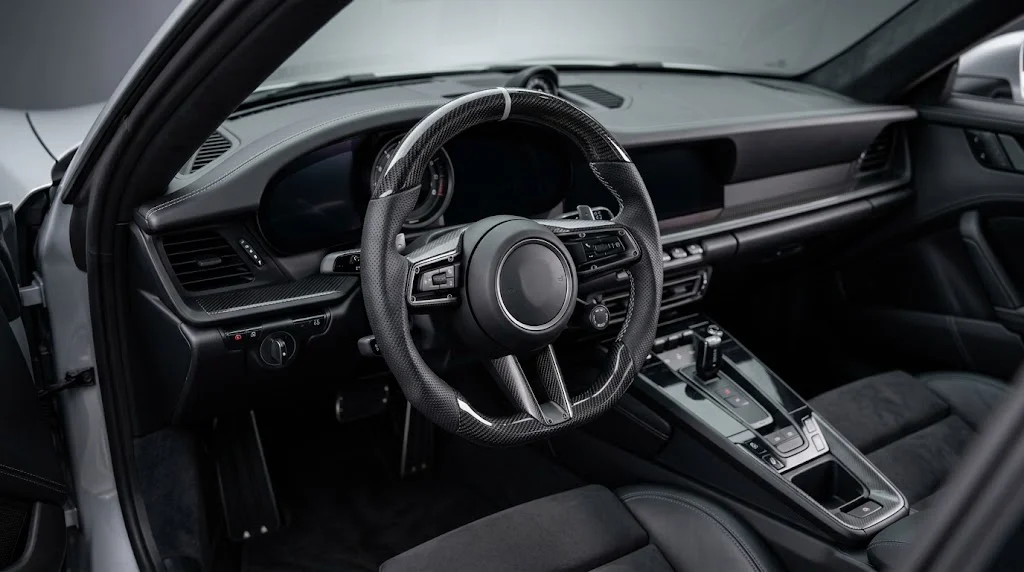
Finish is a preference, but fitment is not. Send the chassis number and the full option list. Add a daylight photograph of the wheel face and one of its rear with the airbag removed. Any Porsche gloss vs matte carbon steering wheel order is confirmed against those details before anything is cut.
The photographs show us the spoke profile, the button cluster and the connector. A 991 and a 992 use different frames, so the model matters as much as the year. We build nothing until the match is confirmed, and we will ask for a clearer picture rather than guess.
A working switch should keep working. Our builds reuse the frame and the wiring already fitted to your car.
| Function | Typical outcome |
|---|---|
| Airbag | Original module normally reused; cover shaped to suit it |
| Multifunction buttons | Retained when the original button frame is reused |
| Paddle shifters | Retained; the paddle cut-outs are set at order |
| Drive mode dial | Retained where the wheel carries one |
| Heated rim | Depends on the heating element and trim; confirm first |
A few items hide behind the rim and each needs its own photograph. One is the heating mat, and the other is the hands-on sensor.
Coding is a separate question from finish. Where the factory module, the wiring and the vehicle-specific parts are reused, further coding may not be needed. A module from another generation is a different situation, and the control unit may then have to learn what is fitted.
Because that depends on the individual car, we describe coding as a possible step rather than a certainty. Send the chassis number with images of both electronic units and we will say whether a workshop visit looks likely.
Faults on these cars rarely come from the finish. They come from fitment. A wheel taken from a neighbouring generation often shares the badge but not the button frame. A heated rim on a car that never had one leaves a spare plug and a switch doing nothing. The opposite error appears just as often. Driver assistance depends on sensing hardware inside the factory rim, so replacing it can raise messages. A cover shaped for a GT airbag arriving on a standard car is the quiet cosmetic failure. The checks above clear every case.
Each finish asks for a different routine. Gloss needs a cloth within reach, because fingerprints appear quickly and water spots are permanent if they dry in the sun. Matte needs far less, but it cannot be polished back if someone tries to add shine to it.
Rain is the other consideration. Water spots dry into gloss and leave a faint ring, so a car kept outside benefits from a quick dry after a shower. The matte coat is more forgiving here, which is one reason it suits daily drivers.
Cleaning rules are simple for both. Rinse and dry gloss immediately rather than letting it air dry. Use a microfibre cloth rather than a paper towel, which leaves lint in the weave. Keep solvents and abrasive polishes away from the stitching on either finish.
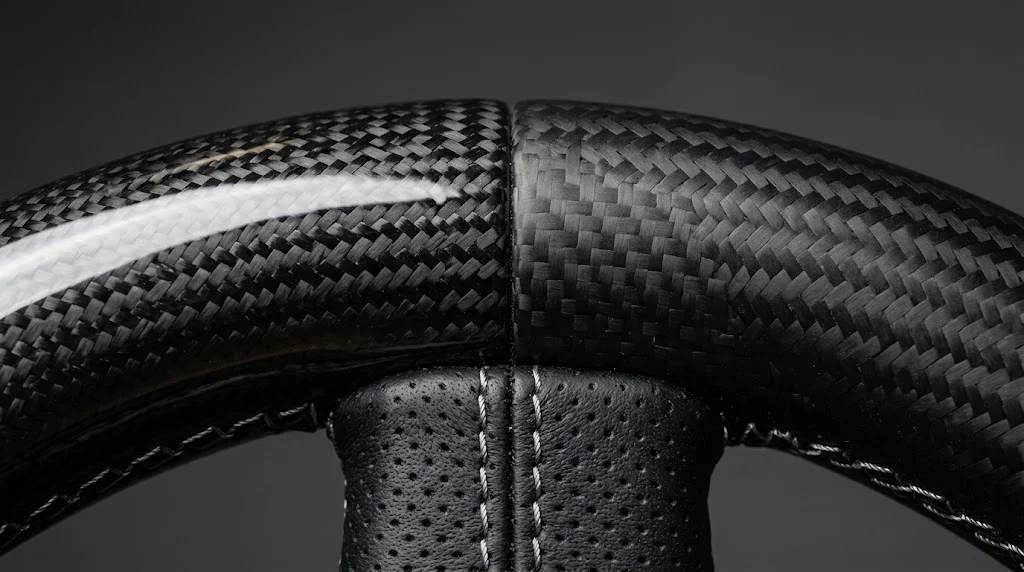
The matte coat hides them. Fine marks scatter light the way the surface already does, so they blend in. A gloss coat shows every line.
Yes, and it is a popular request. A gloss top with a matte base gives contrast without committing to one look.
No. Carbon is decorative on either build, and grip comes from the leather or Alcantara on the side sections.
Not under normal use. It can be polished into a sheen by the wrong cleaner, which is why we advise against abrasives.
Building the wheel takes ten to fifteen working days, and shipping adds fifteen to twenty. The full window from order to arrival is twenty-five to thirty-five days.
Only for a donor build. A newly made core leaves your factory wheel with you.
Once shine is added it cannot be removed, so we advise against polishing a matte rim. Cleaning should stay to a damp cloth and a mild soap.
No. The layup under the coat is identical, so the two options weigh the same and feel the same through the rim.
Every rim is cut, stitched and assembled for one car in our Guangzhou workshop. Thirteen or more years of design, engineering and production stand behind the patterns we offer, so nothing begins before your chassis is confirmed. Finish, stitch and rim shape remain your calls. Shipping is tracked on every order, the warranty lasts three years, and returns are open for thirty days by RMA request.
Two other guides on this site answer the questions that follow this one. The Taycan guide covers the electric saloon and the same finish choices in a bright cabin. The Macan guide deals with the SUV, where dust and sunlight decide the answer. The full range sits in the shop, and the Porsche pages are the brand listing and the 911 page.
Tell us which finish you are leaning towards, add the chassis number and the options list, and send a photograph of the wheel. We will reply with a confirmed build and a date before we make your Porsche gloss vs matte carbon steering wheel. The catalogue holds two entries for this platform. The first is the carbon fibre wheel listed for the 911 991 series. The second is the forged carbon wheel that covers the 718, 992, Panamera and Carrera.
Further notes are there if you need them. The installation guide covers battery isolation and the airbag, and the FAQ answers the common questions. Our about page covers the Guangzhou workshop in more detail. Fitment and delivery queries can go through the inquiry form, or the contact page. Timings are set out in the shipping policy, and returns are governed by the return and refund policy. The warranty position is set out in 15 U.S.C. 2304, and air bag requirements appear in 49 CFR 571.208.
How to specify a custom steering wheel for a Porsche Taycan, from the Y1A saloon to the Cross Turismo: fitment, coverings, coding and safe installation.
Read More →How to specify a custom steering wheel for a Porsche Macan, from the 95B to the XAB: fitment, coverings, coding and what to check before you order.
Read More →How to specify a custom steering wheel for a Porsche Boxster or 718 Boxster, from 986 to 982: fitment checks, materials, installation and coding.
Read More →