
Porsche Steering Wheel Materials: Carbon vs Alcantara vs Leather
Carbon fibre, Alcantara or leather? How the three Porsche steering wheel materials compare on grip, care and wear, and where each belongs on the rim.
Read More →Guide · 10/19/2026
Heat added after the car was built depends on the mat, the column module and the coding. What a Porsche heated steering wheel retrofit involves, chassis by chassis.
Heat is the one rim option that owners notice every morning from November to March. Adding it after the car was built is possible, but the job is not the same on every chassis. This guide explains what a Porsche heated steering wheel retrofit involves, which parts decide the outcome, and where the work stops being a trim job.
Any retrofit needs three things: a heating mat inside the rim, a supply that reaches the column, and a control that switches the heat on. A car ordered without the option may still have two of the three. The missing piece is usually the control. The control is what separates a morning's work from a workshop visit.
Our part of the job is the rim itself. We build the covering, fit the mat, and keep the factory connectors. The electrical side belongs to whoever works on the car, which is why every quote here starts with the chassis number.
Some cars leave the plant with the loom and the module in place, even without the heated option. In those cases the retrofit is mostly a rim and a coding step, because the car already knows how to switch a mat on. It is the cheapest form of Porsche heated steering wheel retrofit, since the expensive parts are already bolted to the column.
Others arrive with a plain column and no circuit at all. Adding one means running a supply and fitting the control, which turns a trim job into electrical work. Nothing about the rim changes between those cases. The labour around it changes, along with the number of parts that have to be sourced before the rim is opened.
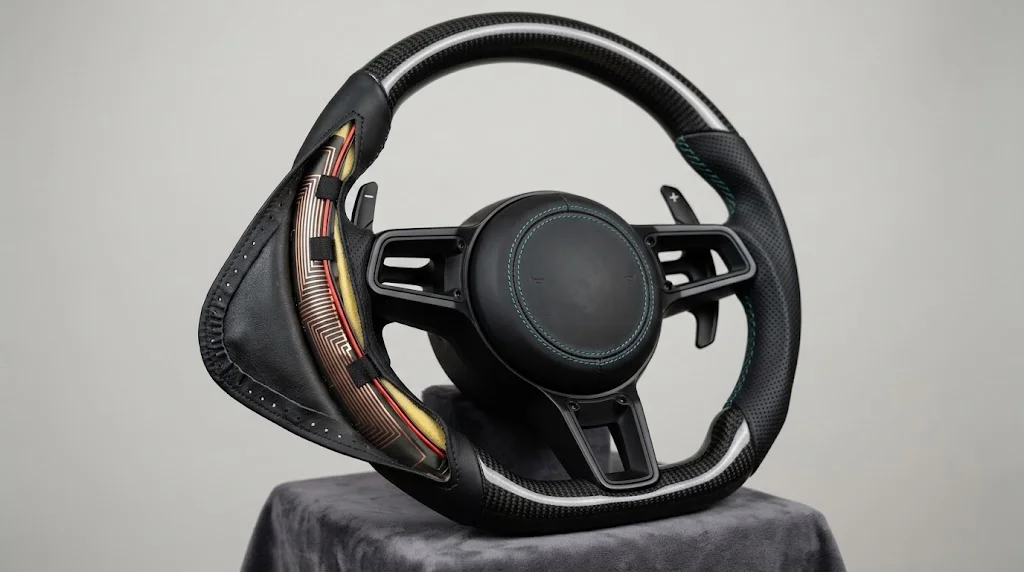
A heating mat is a flat element laid under the covering, with a thermistor beside it to report temperature. The mat has to follow the rim's contour. A mat cut for a round rim will not sit correctly on a flat bottom one. Wiring runs from the mat to a connector at the hub.
Leather carries heat well. Alcantara holds it close to the surface. Carbon panels do not heat at all, so a rim with carbon on the upper arc keeps the mat in the leather or Alcantara sections. The detail is settled at order, because the mat is laid before the covering is stitched.
| Path | What it needs | Best for |
|---|---|---|
| Rebuild your own heated rim | Original mat and module reused | A car that already had the option |
| Add a mat to a plain rim | Mat, connector, supply, control | A car with the loom already fitted |
| Fit a complete heated rim | Rim, module, coding | A car with no circuit at all |
Every path ends with a warm rim. The difference is how much of the car has to be opened up to get there. A Porsche heated steering wheel retrofit that suits one car can be the wrong path for another, which is why the option list comes first.
The steering column control module sits between the button and the mat. It reads the request and switches the current. A module never specified with the heating function leaves the button on the climate panel with nothing to talk to.
Some modules can be coded for the function. Others cannot, and then the module itself has to be changed. The question belongs to a workshop with the car in front of it. It is also the most common reason a retrofit quote moves up or down.
A 992 or a 991 usually has the neatest path, because the option was widely ordered and the parts are well documented. A Taycan follows the same logic, with the added detail that its climate panel groups the heated rim with the seat heating.
Macan and Cayenne cars vary more by year and market. The early Macan was ordered without the option often enough that a plain column is common. Panamera 970 and 971 cars sit in between, with the later cars more likely to carry the circuit. A 718 is the simplest of the group in most cases, because the cabin layout changed little across the run.
Start with the chassis number and the option list. The list settles whether the car left the plant with heating, and the chassis number settles which module was fitted. Add a daylight photograph of the rim and one of its rear with the airbag out.
Then look at the connector at the hub. A car with the heating circuit carries an extra pin, and a photograph of that plug answers more than a parts catalog can. Trim level matters too, since a GT car and a standard car of the same year can carry different bags and different button frames. No core is cut until these are checked.
A warm rim should not cost a working switch. Our builds reuse the parts already fitted to your car wherever the original hardware allows it.
| Function | Typical outcome |
|---|---|
| Airbag | Original unit reused, cover shaped around it |
| Multifunction buttons | Kept when the original frame is reused |
| Paddle shifters | Kept; openings set at order |
| Heated rim | The point of the build; mat and control confirmed first |
| Drive mode dial | Kept where the rim carries one |
| Lane keep and adaptive cruise | Read hardware in the rim, so a swap can raise a message |
The hands-on sensor sits close to the mat and has its own connector. It needs a photograph of its own, because a mat laid over it can leave the car warning about the wheel.
Heating is a function the car has to be told about. When the module already supports it, coding may be a short session. Otherwise coding cannot create the function, and hardware has to change first.
Since that varies by chassis and by build year, we treat coding as a possible step rather than a fixed line item. Pass on the chassis number with photographs of the module and the hub connector, and we will say what the car is likely to need.
Most failed retrofits come from a mismatch, not from the rim. A mat with the wrong resistance reads as a fault. A module without the function ignores the button. A hub connector with one pin fewer cannot carry the supply. A hands-on sensor covered by a mat can trigger a warning at every start. All of these are visible in the photographs and the option list before an order is accepted.
Check the heat with the airbag back in place and the battery connected, on a cold morning if possible. The rim should warm across the grip sections first, then spread. A cold patch at one side usually means the mat has lifted. A lifted mat calls for the trim to come off again rather than for patience. The heat test matters most in a Porsche heated steering wheel retrofit. It catches a lifted mat before the car leaves the workshop.
Listen for the switch as well. A click from the module and a light on the button say the request reached the car. Silence there points at coding or at the module, not at the mat.
Often yes, but it depends on the column module and the loom. A car with neither needs more work than a car with both.
Not when the mat, the module and the coding match. A resistance mismatch is the usual cause of a warning.
Barely. A mat adds little thickness, and a contoured grip section hides what it does add.
It can be laid under the leather or Alcantara sections. Carbon panels do not carry heat, so the mat stays away from them.
Count ten to fifteen working days for the build and fifteen to twenty for shipping. That is twenty-five to thirty-five days from order.
The original unit goes back in the same position. The cover around it is what changes, shaped for the bag your car carries.
Yes, when the rim can be stripped and rebuilt. Photographs come first here, because the covering has to come off to lay a mat.
It depends on the module. Where the fitted unit already supports the heating function, coding may be enough. Where it does not, the module has to be replaced before the rim can be switched on.
Not automatically. Coverage can still depend on whether the work caused the specific failure being claimed.
Each heated rim is built for one chassis in our Guangzhou workshop, with the mat laid and tested before the covering is stitched. Thirteen or more years of design and production stand behind every pattern we cut. Material, stitch and the heated sections stay your decisions. An aftermarket steering wheel does not automatically void a vehicle warranty under U.S. federal warranty law, but warranty coverage can still depend on whether the modification caused the specific failure being claimed. The federal remedy rules appear in 15 U.S.C. 2304, and the warranty-term rules in 16 CFR part 700.
Three pages on this site support the work above. The 911 991 and 992 guide covers the chassis most often ordered with heat. The Taycan guide explains how the climate panel groups the rim with the seats. The shop lists every build we offer.
Send the chassis number, the option list and the two photographs described above, and we will tell you what the car is likely to need. A Porsche heated steering wheel retrofit begins with those details, not with a catalog page. Two entries show the range. One is the Nappa leather rim listed across the 718, 991, 992 and GT cars. The other is the Macan 95B rim with carbon on the upper arc. Fitment questions can go to the inquiry form or the contact page, and the Porsche brand page lists every chassis we cover.
Carbon fibre, Alcantara or leather? How the three Porsche steering wheel materials compare on grip, care and wear, and where each belongs on the rim.
Read More →Gloss or matte carbon on a Porsche steering wheel? How the two finishes differ in sunlight, cleaning and wear, and which suits a 911, 718, Macan or Taycan.
Read More →How to specify a custom steering wheel for a Porsche Taycan, from the Y1A saloon to the Cross Turismo: fitment, coverings, coding and safe installation.
Read More →