The Porsche Heated Steering Wheel Retrofit Explained
Heat added after the car was built depends on the mat, the column module and the coding. What a Porsche heated steering wheel retrofit involves, chassis by chassis.
Read More →Guide · 10/18/2026
Carbon fibre, Alcantara or leather? How the three Porsche steering wheel materials compare on grip, care and wear, and where each belongs on the rim.
Three materials end up on almost every custom Porsche rim: carbon fibre, Alcantara and leather. Each does a different job, and the best builds use more than one. This guide compares the three Porsche steering wheel materials on grip, care and wear, and explains where each belongs on the rim. The differences show up first in how each surface reflects light.
The table sets out the practical differences. Everything after it explains the reasons behind those lines.
| Attribute | Carbon fibre | Alcantara | Leather |
|---|---|---|---|
| Grip when new | Firm on the decorated sections | Firmest of the three | Soft and supple |
| Reflection | Gloss reflects, matte does not | Almost none | Low sheen |
| Cleaning | A wipe with a microfibre cloth | A soft brush every few weeks | A damp cloth |
| Wear pattern | Holds its surface well | Nap flattens where hands rest | Polishes at nine and three |
| Best placed | Upper and lower rim | Side grips | Side grips and lower rim |
Carbon is a layer over a shaped core, so it changes the look rather than the steering. Gloss fills the weave with a polished coat and reflects cabin light. Matte scatters that light and stays quiet, which hides fingerprints far better.
Neither finish is slippery in normal driving, because the grips stay in leather or Alcantara. The panels are usually kept to the upper and lower rim, where hands pass rather than rest. A car parked outside tends towards matte; a garaged one often carries gloss.
Alcantara returns the firmest grip of the three and the least reflection. It also holds heat differently, staying cooler after the car has stood in the sun. For a driver who wants more feedback through the hands, it is the covering that delivers it.
The trade-off is maintenance. The nap gathers oils from bare hands, and it flattens where palms rest over months of use. A soft brush every few weeks lifts it back. Owners who enjoy that small routine usually stay with Alcantara.
The factory covering is leather, and it remains the easiest material to live with. Smooth Nappa is the softest grade and the closest match to a factory finish. Perforated Nappa adds ventilation without changing the feel much.
Leather does polish over time, especially at nine and three where hands sit for hours. That shine is the usual reason an interior starts to look older than its mileage. A retrim in fresh leather is the most direct remedy.
The three Porsche steering wheel materials differ most in how they reflect light, and that difference shapes where each one sits on the rim.
Most of our builds combine two of the three. The upper and lower rim take the carbon, the grips take the leather or Alcantara, and the stitching links the wheel to the seats. That arrangement keeps the driver's hands on a surface that grips.
Cost is rarely the deciding factor. The three Porsche steering wheel materials sit within a similar price range once the build is specified. The choice usually follows how the car is used and how much upkeep the owner wants. A track car and a daily car rarely land on the same answer.
Three-material builds also work. Forged carbon at the top, perforated leather on the grips and Alcantara at the base gives a car three textures without looking busy. The layout is settled at order, because the segments are cut before the covering is stitched.
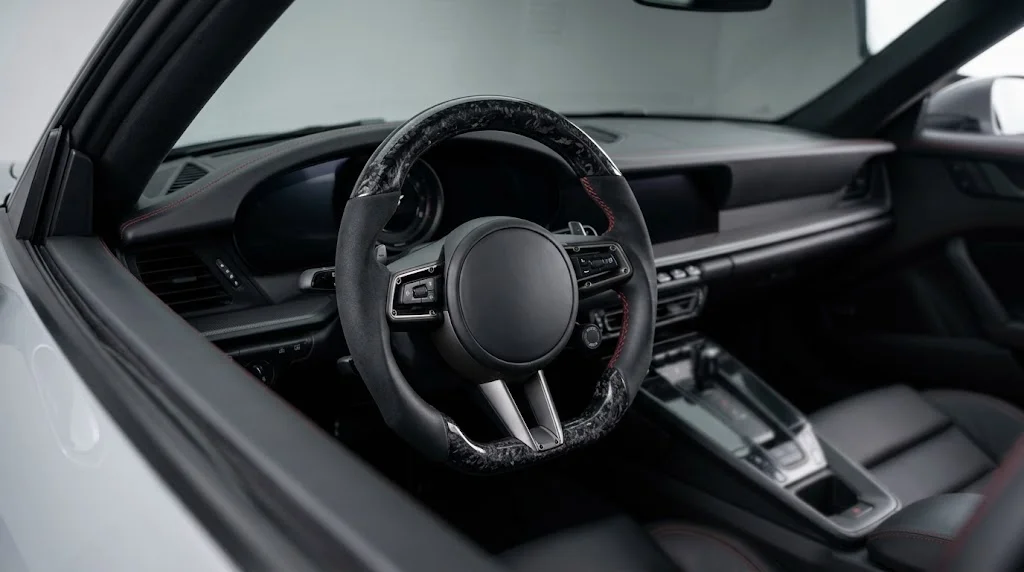
A 911 used on road and circuit often suits Alcantara on the grips, because the driver wants feedback and accepts the brushing routine. A Panamera or a Cayenne used for distance tends towards leather, which asks for less attention.
A 718 with a bright interior can carry carbon on the upper rim without looking busy. On a Taycan, the quiet cabin makes a low-sheen material the calmer choice. None of this is fixed, and the final decision stays with the owner.
Send the chassis number and the full option list first. Add a daylight photograph of the wheel face and one of its rear with the airbag removed. Whether a rim in your chosen material fits the car turns on those details rather than on the model badge.
Cars of the same year can leave the factory with different clusters. The photographs show us the spoke profile, the cluster and the connector shape. We cut nothing until the match is confirmed, and we will ask for a clearer picture rather than guess.
The covering should not cost you a working switch. Our builds reuse the frame and the wiring already fitted to your car.
| Function | Typical outcome |
|---|---|
| Airbag | Original module normally reused; cover shaped to suit it |
| Multifunction buttons | Retained when the original button frame is reused |
| Paddle shifters | Retained; the paddle cut-outs are set at order |
| Drive mode dial | Retained where the wheel carries one |
| Heated rim | Depends on the heating element and trim; confirm first |
The heating mat and the hands-on sensor sit behind the rim. Both need their own photograph, and neither can be judged from the front face.
The covering has no bearing on coding. What matters is the electronics you reuse. Keep the factory module, the loom and the car-specific parts, and the car may need no further programming. A unit from another generation is a different case.
Since that varies between vehicles, coding is described as a possible step rather than a certainty. Send the chassis number with photographs of both electronic units, and we will say whether a workshop visit looks likely.
Problems on these cars rarely come from the material. They come from fitment. A wheel from another generation often shares the badge but not the button cluster. A heated rim added to a car that never had one leaves an unused plug and a control doing nothing. The reverse happens just as often. Assistance systems read hardware inside the factory rim, so replacing it can raise messages. A cover shaped for a GT airbag arriving on a standard car is the quiet cosmetic failure. The checks above clear every case.
Each of the three Porsche steering wheel materials ages in its own way. It softens and then polishes. Alcantara flattens and recovers with brushing. Carbon stays much as it was fitted, apart from dust. Knowing that in advance makes the choice easier.
Cleaning follows the same idea. A microfibre cloth and a mild soap handle carbon and leather. A soft brush is the only tool Alcantara needs. Solvents and abrasive polishes do more harm than good on all three, so keep them away from the stitching.
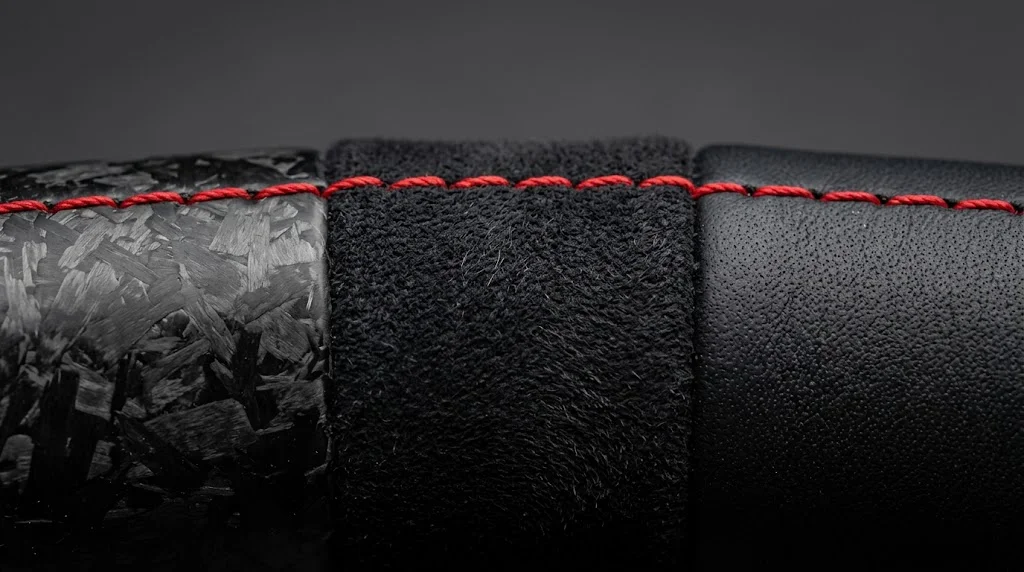
All three last well when they are maintained. Leather shows its age through polishing, Alcantara through flattened nap, and carbon very little at all.
Not on the sections where it is used. Hands rest on the grips, which stay in leather or Alcantara, so the carbon is rarely in prolonged contact.
Yes. Forged carbon, perforated leather and Alcantara can be combined on one rim, with each material taking the section it suits.
Only a soft brush. A damp cloth is not enough on its own, because the nap needs lifting rather than wiping.
Building the wheel takes ten to fifteen working days, and shipping adds fifteen to twenty. The full window from order to arrival is twenty-five to thirty-five days.
Yes, but it means a fresh covering rather than a repair. The core can be rebuilt, and the original wheel may be kept for a return to standard.
A well-finished wheel rarely hurts a sale, and a tidy rim helps a private sale. Keeping the original lets you put the car back to standard.
Yes, within the thread range we keep. A photograph of the seats in daylight lets us match as closely as the material allows.
Every rim is cut, stitched and assembled for one car in our Guangzhou workshop. Thirteen or more years of design, engineering and production stand behind the patterns we offer, so nothing begins before your chassis is confirmed. Material, stitch and rim shape remain your calls. Shipping is tracked on every order, the warranty lasts three years, and returns are open for thirty days by RMA request.
Two other guides on this site answer the questions that follow this one. The gloss versus matte guide settles the finish once the material is chosen. The Taycan guide covers the electric car and the same material choices in a quiet cabin. The full range sits in the shop, and the Porsche pages are the brand listing and the 911 page.
Photograph the wheel and the interior, add the chassis number and the option list, and send them across. We will reply with a confirmed build and a date before we make your Porsche steering wheel in the materials you choose. Two catalogue entries show the range. The first is the nappa leather wheel listed across the 718, 991, 992 and GT models. The second is the GT-style Alcantara wheel built for the Boxster and Cayman.
Further notes are there if you need them. The installation guide covers battery isolation and the airbag, and the FAQ answers the common questions. Our about page covers the Guangzhou workshop in more detail. Fitment and delivery queries can go through the inquiry form, or the contact page. Timings are set out in the shipping policy, and returns are governed by the return and refund policy. The warranty position is set out in 15 U.S.C. 2304, and air bag requirements appear in 49 CFR 571.208.
Heat added after the car was built depends on the mat, the column module and the coding. What a Porsche heated steering wheel retrofit involves, chassis by chassis.
Read More →Gloss or matte carbon on a Porsche steering wheel? How the two finishes differ in sunlight, cleaning and wear, and which suits a 911, 718, Macan or Taycan.
Read More →How to specify a custom steering wheel for a Porsche Taycan, from the Y1A saloon to the Cross Turismo: fitment, coverings, coding and safe installation.
Read More →